The plot works. Now make it feed you all year.
Year one is about getting anything at all to grow. Year two is when you see the shape of the real problem: far too much in August, and nothing worth carrying home in April.
This is the fix. Rotation that fits four beds, succession sowing that actually works, and a plan for eating from the plot in every month of the year.
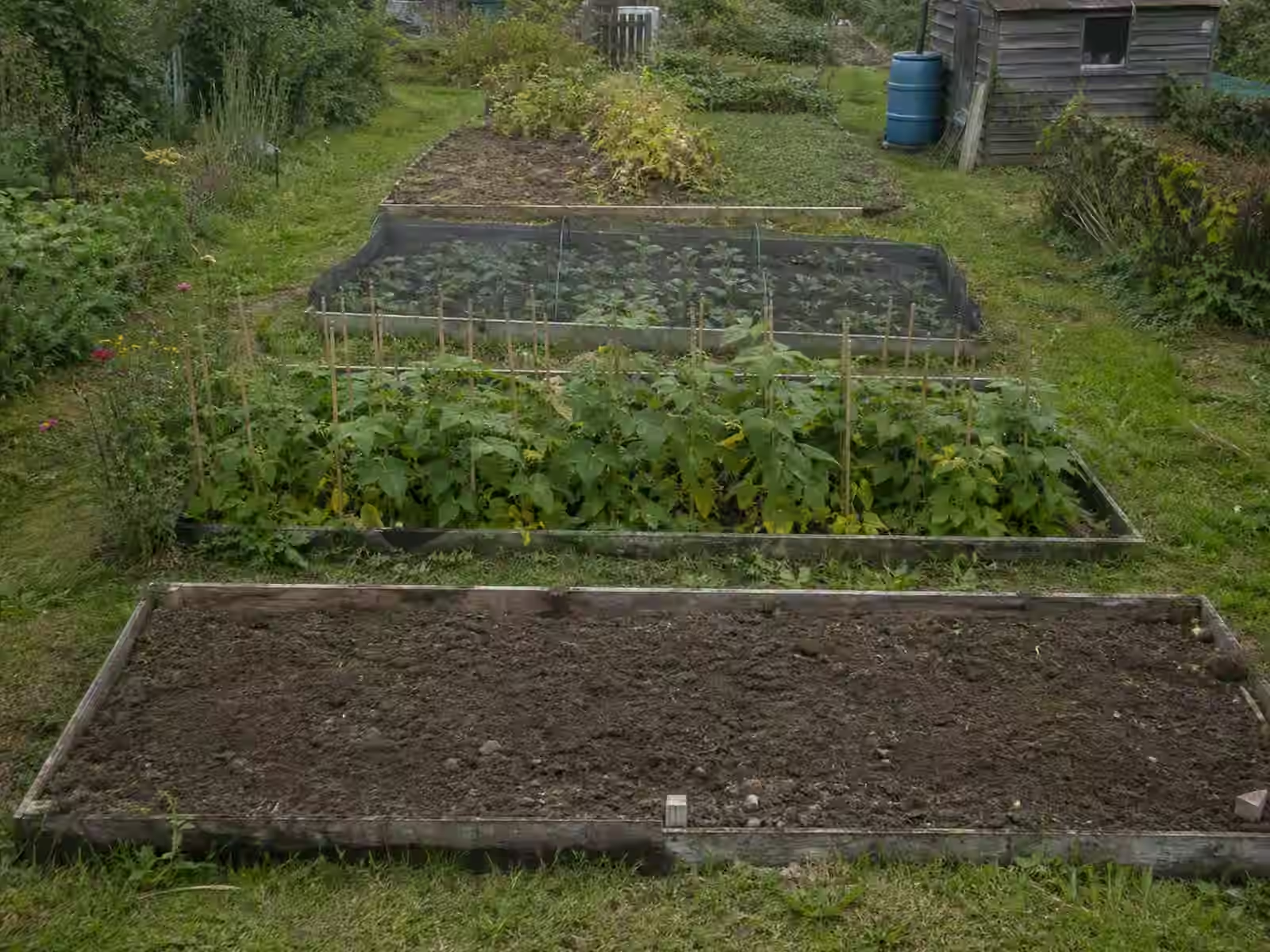
The glut and the gap are the same mistake
Improvers usually arrive with two complaints, and treat them as separate problems. In August there is more than anyone can eat and half of it goes over before it is picked. In April there is nothing, and the plot looks like a building site with a few leaves on it.
They are the same mistake seen from opposite ends of the year. Everything was sown in one go, in one short window in spring, because that is when it feels like the season starts.
Sow everything at once and it is ready at once. Then it is over at once, and the ground sits empty for the eight months that follow.
Stop thinking in a growing season. Start thinking in twelve months.
A half plot has room to feed a household for far more of the year than most plots actually do. Not because of anything clever, but because most beds are only asked to produce one crop, in one window, and then sit bare.
Three habits change that, and the rest of this page is those three:
Rotate, so each bed gets what the last crop left behind.
Sow little and often, so nothing arrives all at the same moment.
Sow in summer for winter, which is the one almost nobody does.
A four bed rotation, scaled to a half plot
Textbook rotations run to seven groups and assume a walled garden. Four beds and four groups fit a half plot, and the order is not arbitrary: each group leaves the soil in the state the next one wants.
Potatoes
Goes into the bed that got the compost. Potatoes are hungry, and the digging and earthing up breaks up and cleans ground better than any other crop.
Leaves behind: loose, weed free, well worked soil.
Beans and peas
Follows potatoes into that loose soil, which suits deep rooting legumes. Needs no extra feeding, so nothing is wasted.
Leaves behind: nitrogen fixed in the roots, if you cut the plants off at ground level and leave the roots in.
Brassicas
Cabbage, kale, sprouts and purple sprouting broccoli follow the beans and take up that nitrogen, which is exactly what leafy crops want. Give this bed compost too, and firm it well: brassicas need firm ground to stand up through winter wind.
Leaves behind: firm soil, low fertility.
Roots and onions
Carrots, beetroot, parsnips and onions go last, into the leanest bed in the rotation. This is deliberate. Fresh manure or rich soil makes roots fork and split, and onions grow soft and store badly.
Leaves behind: a bed ready for compost, and back to potatoes.
Where the compost goes
Two beds out of four, every year: the potato bed and the brassica bed. The bean bed does not need it and the root bed is actively harmed by it. That halves the amount of compost a half plot needs, which matters when you are making it yourself.
What sits outside the rotation
Perennials do not move: rhubarb, herbs and any soft fruit get their own permanent corner. Courgettes, squash and salad are the flexible ones and can be slotted into whichever bed has a gap, since they belong to none of the four groups and take nothing personally.
Why four years is enough
The reason for rotating at all is soil borne trouble that builds up under one crop family: clubroot in brassicas, eelworm in potatoes, white rot in onions. A four year gap handles most of it on a half plot. The seven year version exists for growers whose living depends on never getting it wrong.
The honest limit
Rotation is prevention, not cure. If clubroot is already in your soil, moving the brassicas one bed along will not save them, and it can persist for twenty years. If your site has it, ask the secretary before you plan around it, and raise your plants in modules so they go out with a decent root system already made.
Succession sowing, and the intervals that actually work
Little and often, so that nothing arrives all at once. The hard part is not the idea, it is remembering to do it in June when the plot is already asking for everything you have.
Salad leaves every 2 weeks, March to September
Radish every 2 weeks, March to August
Spring onions every 3 weeks, March to July
Peas every 3 weeks, March to June
Turnips every 3 weeks, April to August
Beetroot every 3 to 4 weeks, April to July
Carrots every 3 to 4 weeks, March to July
French beans two sowings only, mid May and late June
Calabrese every 4 weeks, April to June
A sowing is a 1m row, not a full bed row. That is the part people get wrong.
Sow a metre, not a row
The instinct is to sow the full length of the bed because you are there with the packet open. Resist it. A single metre of carrots or salad is roughly what a household gets through before the next batch is ready, and it is the whole mechanism: small amounts, close together in time.
Use germination as the trigger, not the calendar
This is the trick that makes succession sowing survive a busy summer. Do not sow on fixed dates. Sow the next batch on the day you see the last batch come through the soil.
It self corrects for the weather, which a calendar cannot. In a cold May everything slows down together and your sowings space themselves out. In a warm June everything speeds up and so do you. It also turns an abstract intention into a visible cue on the plot, which is why it actually gets done.
Know which crops it does not suit
Succession is for fast crops. It is wasted on anything that occupies a bed for most of the year. Parsnips, sprouts, kale, purple sprouting broccoli, leeks, onions, garlic, maincrop potatoes and winter squash all get one sowing at the right moment and then hold their ground. Trying to succession sow those is how you end up with a bed of half grown parsnips in November.
Eating from the plot in every month
What is actually ready, month by month, and the sowing months that produced it. The second line is the one that matters.
Leeks, parsnips, kale, sprouts, winter cabbage
Plus stored onions, garlic and squash on the shelf. The plot looks dead and is quietly feeding you.
Sown: leeks in March, sprouts and parsnips in April, kale in May. All of it a year earlier.
Purple sprouting broccoli, spring cabbage, overwintered salad, rhubarb
The hungry gap. Thin pickings, and the months that separate a plot that works from a plot that stops in October.
Sown: purple sprouting in May the previous year, spring cabbage in August, salad in September.
Broad beans, first peas, early potatoes, radish, salad, asparagus
The relief month. Broad beans in particular arrive exactly when nothing else has.
Sown: broad beans in November, potatoes planted in March, salad from March onwards.
Runner and French beans, courgettes, tomatoes, beetroot, carrots, onions, garlic
More than you can eat, which is the problem this page exists to solve.
Sown: mostly April and May. Which is exactly why it all lands at once.
Maincrop potatoes, winter squash, tomatoes, autumn salad, chard, first leeks
The storing months. What goes onto the shelf now is what you eat in January.
Sown: squash in April, maincrop potatoes planted April, autumn salad in July and August.
Leeks, kale, sprouts, parsnips, winter cabbage
Standing in the ground and pulled as needed, which beats any freezer.
Sown: leeks March, sprouts April, kale May. Nothing sown after August appears on this line.
The thing to notice
Read down the green line. Almost everything you eat between November and April was sown between March and August, and nothing sown after the end of August appears on it at all.
Winter is not a growing season on a UK allotment. It is a standing and storing season. Which means every decision about whether you eat in February gets made while you are at your busiest, in the middle of summer, when the plot is full and thinking about January feels ridiculous.
That is the whole of year round planning. Not more work, just work moved to a month that feels wrong.
A reminder in the month it matters.
The August sowings that feed you in February are easy to miss when the plot is at its busiest. One email at the start of each month, with what to sow now for later.
One email a month. Unsubscribe any time.
Where to go next
The two deeper guides, and the hub for when doing less starts to matter more than growing more.
Go deeper on succession
The full method, crop by crop, with what to do when you fall behind.
Plan the winter properly
What to sow in late summer so that you are still picking in February.
Year five and beyond
When the question stops being how to grow more and becomes how to do less.