Eight years, half a plot, and a long list of things that did not work.
I am Sam, and I grow a half plot on a council site in Nottinghamshire. I took it on knowing essentially nothing, lost most of the first summer to bindweed, and grew about forty courgettes that nobody wanted.
Everything on this site is what I wish somebody had told me then: written plainly, scaled for half a plot rather than a smallholding, and honest about how long things actually take.
Why a site only about half plots
A full allotment plot in the UK is usually around 250 square metres. A half plot is around 125. That sounds like simple halving and it is not. It changes which crops are worth growing at all, how much of the year you can realistically cover, and how much of your Saturday the whole thing takes.
Almost nothing is written for that size. The advice that does exist tends to be scaled wrong in one of three directions, and following any of it costs you a season before you work out why it is not fitting.
Scaled too big
Most gardening books and the older allotment manuals plan for a full plot, often assuming somebody retired who is down there most days. The rotations run to seven groups, the sowing plans assume a greenhouse and a cold frame, and the harvest tables assume you want to store enough potatoes for a winter. Follow them on a half plot and you end up with a quarter of everything and enough of nothing.
Scaled too small
Container and small garden veg content is scaled the other way. It is written for a patio, a raised bed by the back door and a sunny windowsill, so it optimises for tiny yields and neat arrangements. A half plot is not a large garden. It is open ground with weeds arriving from three sides, wind across it, and no tap within thirty metres.
Written for another country
A great deal of vegetable growing content online is American, written for a climate that is not ours. The frost dates, growing zones, varieties and pests do not transfer. It usually carries a homesteading frame as well, self sufficiency and putting food by, which is a different project from what most British plotholders are doing, namely growing some of their vegetables, some of the year.
So this site is written for the middle case and only for it. Four beds, two to four hours a week, British weather, and a household that also does a great many other things.
The plot this is written from
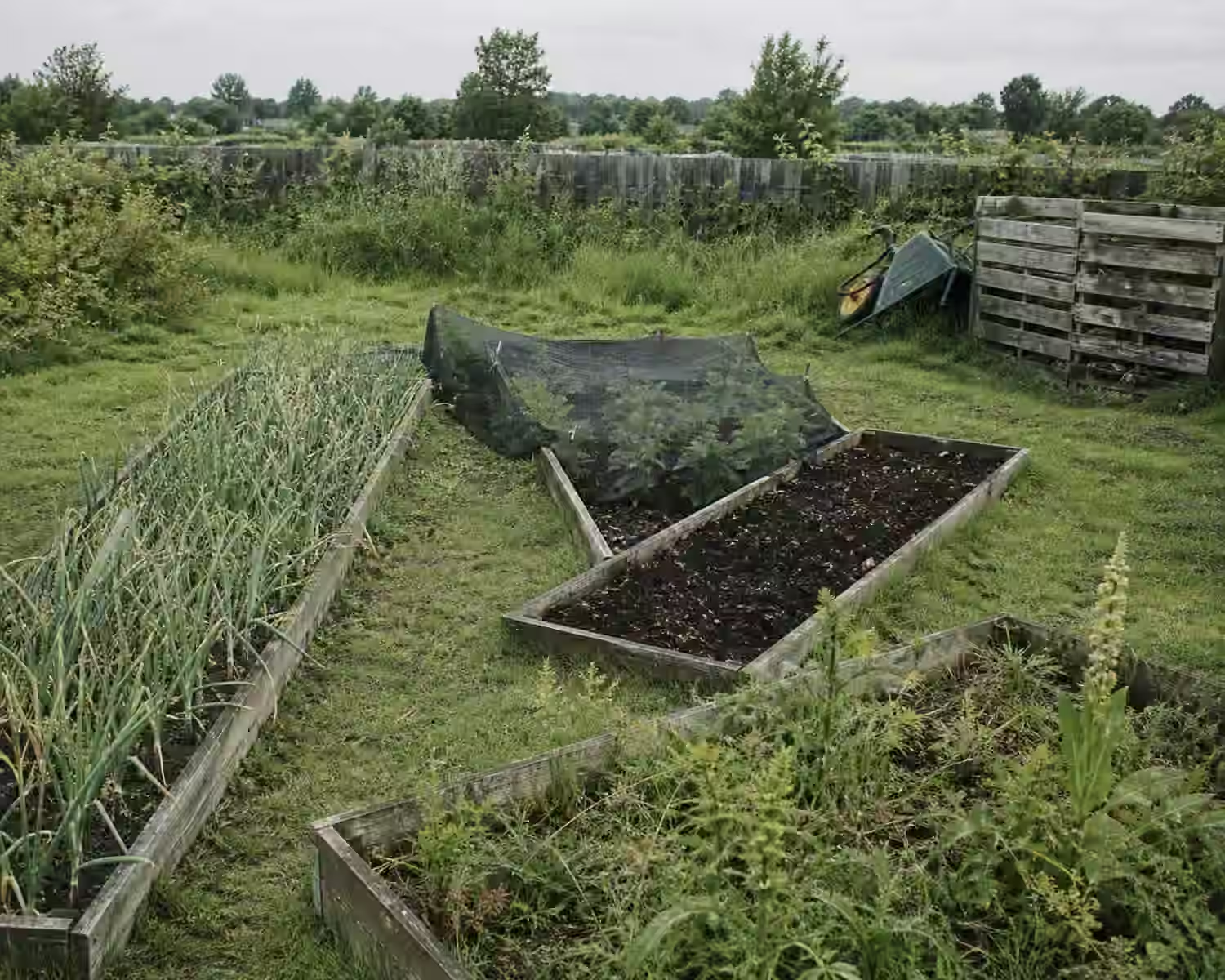
A half plot in Nottinghamshire, five poles of it, on a site with about sixty others. Four beds of scaffold board, each 1.2m wide because that is as far as I can comfortably reach from both sides without standing on the soil. Permanent grass paths between them. A compost mulch that goes on every autumn, two water butts, and a rhubarb crown in the corner that was there long before I was.
It is not a showpiece. There is couch grass along one boundary I have never fully beaten, the netting over the brassicas sags, and there is always at least one bed I have let go by August.
That is more or less the point. Everything here is written from a plot in that condition, because that is the condition most plots on most sites are actually in. The immaculate plot by the gate belongs to somebody who is there five days a week, and writing for their plot would be no use to you.
What I have got wrong, in order
One of the things this site is supposed to be is honest, which is easy to put on a values list and harder to actually print. So here is the list. Most of the guidance on this site exists because of one of these, and I still add to it most years.
Cleared the whole thing in March
All 125 square metres, by hand, across about five weekends. It looked magnificent for a fortnight. By the middle of June it had grown back, I was worn out and quietly resentful about it, and I had actually planted around a third of the ground. The advice on this site to clear one bed properly and put the rest under cardboard comes directly out of that spring.
Assumed bindweed could be dug out once
It cannot. Every fragment of root left behind becomes a new plant, and a fragment is about 5cm long. I dug the same bed three times that summer and it came back stronger each time. What actually works is a full season under light proof cover, or pulling every single shoot the week it appears for two or three years until the root runs out of stored energy. There is no quick version, and anyone selling you one has not had it.
Sowed the whole packet in one go
A full packet of radish down a 3m row. Several hundred were ready in the same fortnight and we ate perhaps thirty. Then I did the same thing with lettuce, and again with rocket. Sow a metre, wait until it germinates, then sow the next metre. It took me two more seasons to actually do that rather than simply know it.
Planted three courgettes
One courgette plant will feed a household of four. Three will feed a street, and they will do it across the same three weeks in August. I grew about forty that year and gave away maybe a dozen before people began taking the long way round to avoid me at the gate. It is the most common half plot mistake there is and I made it in the most obvious way available.
Watered the onions in July
It was dry, and watering felt like the responsible thing to do. They lifted perfectly well and then went soft in the shed by early November instead of lasting into March. Onions and garlic want to dry down and ripen from midsummer onwards. Watering them late puts water into a bulb whose whole job at that point is losing it.
Sowed two year old parsnip seed
Bought on a three for two, kept in the shed over winter, sown the following March. About a dozen plants came up in a 3m row. I re-sowed in May with a fresh packet and got a proper row, three weeks behind. Parsnip seed lasts one year, and a shed is the worst place in Britain to store seed because it swings from freezing to warm and damp. Both of those facts are on the systems page because of that row.
How the guidance here is put together
Four rules that decide what goes on a page and what stays off it. They are worth knowing, because they explain why some things you might expect to find here are deliberately missing.
Dates are UK dates, and they are ranges
Sowing and planting dates on this site suit most of England and Wales in an ordinary year. In Scotland, the far north, or anywhere high up, add a fortnight to anything sown outdoors in spring and take a fortnight off the autumn end. On the south coast you can usually go a week early. A single fixed date is a lie about British weather, so you will find ranges here and a note on what to watch for instead.
Everything is scaled to four beds
Every quantity, spacing, interval and plan on this site assumes a half plot of roughly 125 square metres, four growing beds, and two to four hours a week across two visits rather than one long Sunday. Where something only really works at a larger scale, or needs more time than that, it says so on the page rather than leaving you to discover it in August.
Nothing is called easy
A season takes a season. If a job takes three years, the page says three years. Clearing bindweed is slow, a new plot is hard work for two springs, and April is genuinely bleak. The fastest way to make this site useless would be to tell you something is quick when it is not, because you would plan around it and lose the year.
Corrections get made properly
If something here is wrong, out of date, or simply does not match what happens on your site, say so through the contact page. Genuine corrections are made to the page itself rather than left buried underneath it, and anything substantial gets a line saying what changed and when. There are no sponsored posts and no paid placements anywhere on this site.
What this site is not
Worth saying plainly, so you know within a minute whether to bookmark it or go somewhere better suited.
Not a plant encyclopaedia
There are excellent ones already and the RHS runs the best free one in the country. This site covers a deliberately short list of crops and jobs that earn their place on half a plot, and leaves the other several hundred vegetables alone. If you want to know about salsify, this is the wrong website and that is on purpose.
Not a diagnosis service
Nobody here can tell you what is wrong with your brassicas from a photograph, and guessing at plant health problems by email is exactly how bad advice spreads. Your site secretary and the plotholders either side of you will beat any website in the country on this, because they know what your particular site does in a wet spring and which pest arrives first.
Not about self sufficiency
The aim here is eating something you grew in every month of the year, which is achievable on a half plot and genuinely worth doing. Feeding a household entirely from 125 square metres is a different and much larger project, and it needs more ground, more time and more storage than a half plot has.
Not a shop
Nothing on this site is behind a paywall and there is nothing to buy at the moment. If that ever changes it will be obvious, it will be said plainly, and the guidance on the site will stay free and stay where it is.
Where you probably want to start
Three ways in, depending on which season you are actually in rather than which one you would like to be in.
Year one
You have the keys and the plot looks like a great deal more than 125 square metres. Your first month, one week at a time.
Years two to four
Things grow now, but it all arrives in August and there is nothing worth carrying home in April. Rotation and succession.
Year five and beyond
The plot works and the shortage is hours. How to do less rather than more, without the plot going backwards.
A note from the plot, once a month.
What to sow, what to pick, and what I got wrong that month. One email at the start of each month, nothing else, and you can leave whenever you like.
One email a month. Unsubscribe any time.
What arrives in your inbox
If the monthly note is the only part of this site you ever read, that is a perfectly good outcome. Here is exactly what it is before you decide.
The monthly note
Four short parts, under 400 words, twelve times a year. What is in it and what it will never do.
The long version
Everything in the email, written out in full, one page per month.
How your details are handled
Plain English, no legalese, and what you can ask us to delete.
If you want to get in touch
Corrections, questions about something on a page, or a note to say that a sowing date is a fortnight out where you are. All of it is genuinely useful, and the last one especially, because this site is written from one plot in one place.