Allotment words explained
Every hobby has its own vocabulary and allotments have more than most. None of it is complicated once somebody tells you plainly. Here is the lot, roughly in the order you will meet it.
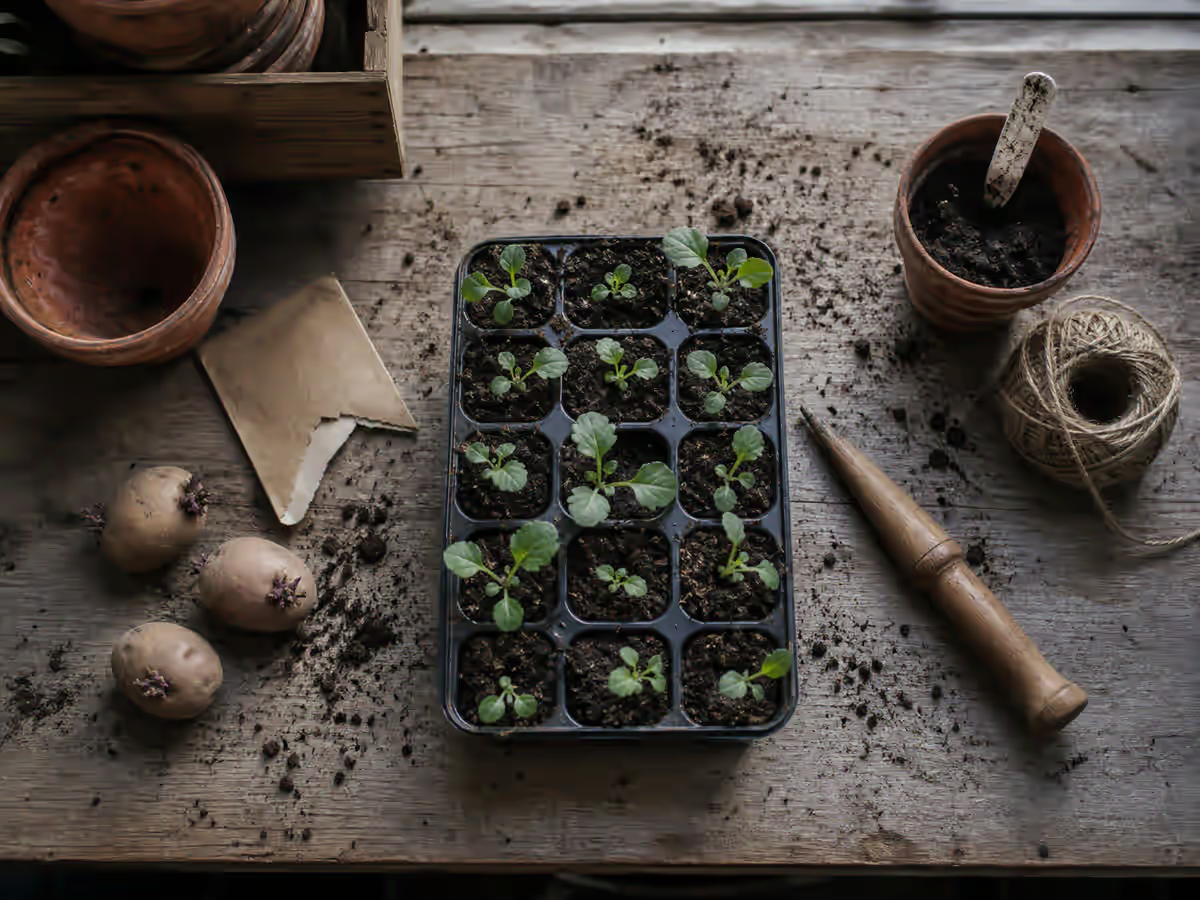
Nearly all allotment jargon is one of three things: a step in raising a plant (prick out, pot on, harden off, plant out), a soil job (tilth, mulch, no dig, green manure), or site admin (cultivation clause, notice, trading hut). Learn those three groups and the rest follows on its own.
What do the sowing words mean?
These describe one sequence, from seed to plant in the ground. Most beginner losses happen because a step gets skipped, not because the seed was poor.
| Word | What it means | Where you meet it |
|---|---|---|
| Sow direct | Seed goes straight into the ground where the plant will grow | Carrots, parsnips, beetroot, salad, beans |
| Sow under cover | Seed goes into a tray or pot indoors, on a windowsill or in a greenhouse | Tomatoes, courgettes, brassicas, leeks |
| Drill | The shallow straight groove you sow into, drawn with the corner of a hoe | Any direct sowing in rows |
| Station sowing | Two or three seeds at each final spacing, thinned later to the strongest | Parsnips, sweetcorn, beetroot |
| Prick out | Lifting tiny seedlings out of a crowded tray into their own modules | Two to three weeks after sowing under cover |
| Pot on | Moving a plant into a larger pot because it has filled the last one | When roots show at the drainage holes |
| Harden off | Standing plants outside by day and bringing them in at night, for a week or two | The fortnight before planting out |
| Plant out | Moving a raised plant to its final position on the plot | After the last frost, for anything tender |
| Thin | Pulling surplus seedlings so the rest have room to size up | Once seedlings have their first true leaves |
Skipping hardening off is the commonest way a windowsill of healthy plants dies over a single weekend. Two weeks of carrying trays in and out feels daft and it is the whole difference between a courgette plant and a dead courgette plant.
What do the soil and bed words mean?
| Word | Plain English |
|---|---|
| Tilth | The crumbly surface you rake soil down to before sowing. A fine tilth means crumbs about the size of breadcrumbs |
| No dig | Leaving the soil structure alone and adding compost on the surface instead of turning it over |
| Mulch | Any layer spread on the surface: compost, woodchip, straw, cardboard, grass clippings |
| Green manure | A crop grown to be cut down and left rather than eaten. Covers and feeds the soil over winter |
| Earthing up | Drawing soil up around potato stems as they grow, to protect shoots and keep light off the tubers |
| Bolting | A plant running to flower and seed early, usually after heat or dryness. Leaves turn bitter |
| Chitting | Standing seed potatoes somewhere cool and light so they sprout before they go in |
| Catch crop | A fast crop squeezed into a bed between two slow ones |
| Cloche | Anything clear placed over a row to warm the soil and keep frost off |
| Blanching | Two meanings. Keeping light off a crop to keep it pale and sweet, and dunking veg in boiling water before freezing |
Blanching is the one that catches people out, because both meanings turn up on this site. On a leek page it means earthing up for a white shank. On the glut page it means ninety seconds in a boiling pan.
What is the hungry gap, and what is a glut?
These two shape a growing year more than any other pair of words on this page.
The hungry gap runs from roughly April into early June. Last autumn’s stored crops have run out or gone soft, and this year’s sowings are in the ground but nowhere near ready. It is the leanest stretch of the British growing year, and it catches almost everyone in year one because it arrives at the exact moment the plot finally looks busy.
A glut is the opposite problem and it lands in July and August. Courgettes, runner beans and tomatoes ripen faster than one household can eat them, and the waste is what puts people off growing them again the following year.
Nearly all year-round planning on a half plot is an attempt to shrink the first and flatten the second. Succession sowing, winter crops and storing are the three tools for the job.
The hungry gap is not a failure of your plot. It is a feature of the British year, and you plan for it the previous August.
Which words are about the site, not the growing?
The tenancy vocabulary. Worth knowing before your first site meeting rather than after it.
| Word | What it means |
|---|---|
| Half plot | Roughly 125 square metres, about half a traditional plot. What most sites now offer new tenants |
| Rod | The old unit plots were measured in. A ten rod plot is about 250 square metres |
| Cultivation clause | The part of your tenancy setting out how much of the plot must be in active use, often 75 per cent |
| Notice | A written warning from the committee that a plot is not being worked. Usually gives you a season to put it right |
| Site secretary | The volunteer holding the waiting list, the keys, the water rota and most of the answers |
| Trading hut | The on-site shop, often open Sunday mornings only, selling seed, canes, netting and manure cheaply |
| Statutory site | A site the council cannot sell without government consent. Worth knowing which yours is |
| Dig for Victory | The wartime campaign most older sites date from. It is why plots are the size and shape they are |
If you are ever sent a notice, reply to it. Committees almost always extend a deadline for someone who answers and turns up. They rarely extend one for silence.
Questions that come up
The five asked most about allotment vocabulary.
Do I need to learn the Latin names?
No. We use plain English throughout this site. Latin only earns its keep when two very different plants share a common name, and on a half plot that almost never happens. Nobody on your site is going to ask you for a binomial.
What does F1 mean on a seed packet?
A first generation cross between two parent lines. F1 seed is uniform, vigorous and more expensive, and seed saved from it will not come true next year. That last part is the only bit that matters for a half plot grower, and it is covered on our seed saving page.
What is the difference between a variety and a cultivar?
Practically nothing, for our purposes. A variety occurs naturally, a cultivar was bred deliberately. Seed catalogues use the words interchangeably and so do we.
Why is it called a ten rod plot when nobody uses rods?
Because plots were laid out before metric and the name stuck. A rod is about 5m, so ten rods is 250 square metres, which was reckoned to be enough to feed a family of four. A half plot is half of that, and for most households today it is plenty.
People on my site keep saying “the lottie”. Is that a real word?
Entirely. It is just affectionate shorthand for the allotment, and you will hear it more in some parts of the country than others. Use it or do not, nobody minds either way.
The words are easier when they arrive one month at a time.
A short email at the start of each month: what to sow, what to pick, and the one job worth doing.
One email a month. Unsubscribe any time. How we look after your details.
Where to go next
If you are brand new
Four weeks, four jobs, and permission to go slow.
The two words that matter most
The lean spring and the crowded summer, both in full.
Every crop, explained
Fifteen guides using these words in context, one crop at a time.