The plot can already grow more than you have time for.
By the fifth season the problem is rarely knowledge. You know what to sow and roughly when, the rotation runs itself, and the soil is better than it was. What runs out is Tuesday evening, and the plot does not care.
This is the hub for doing less. Weeding and watering designed out rather than kept up with, crops that work while you are elsewhere, and an honest account of what no dig does and does not fix.
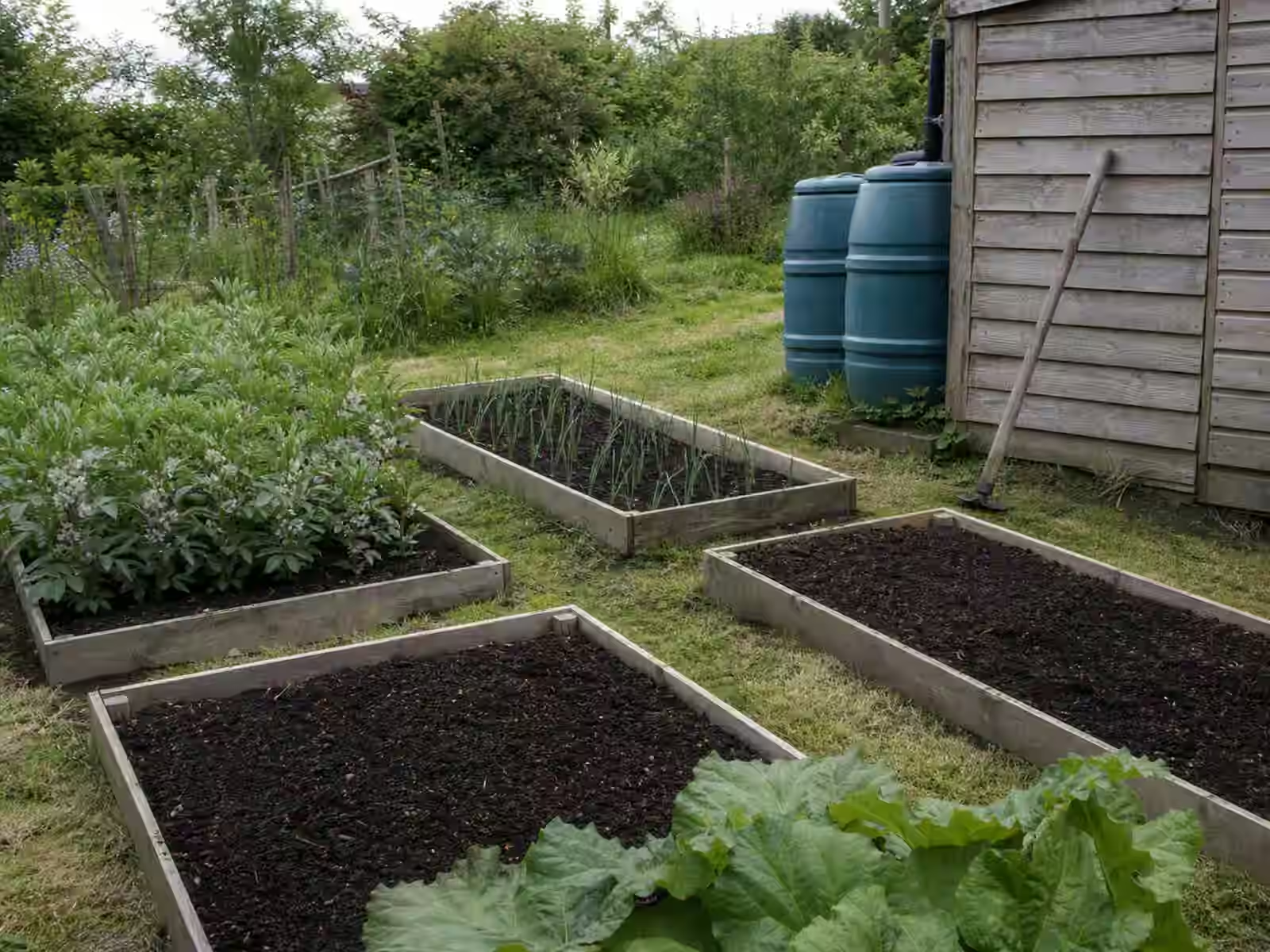
By year five the limit is hours, not knowledge. The fix is fewer decisions. Mulch so there is less to weed, grow the things that crop while you are somewhere else, water only what actually needs it, and drop the five jobs that cost the most and return the least.
By year five the shortage is hours, not know how
Something shifts around the fifth season. The plot is capable. You are capable. And it still gets away from you in the second week of July, because the limit was never really knowledge.
So everything on this page is subtraction. Not another bed, not another crop, not a better shed. Fewer jobs, done less often, on a plot arranged so that most of the work never needs doing in the first place.
The two jobs that swallow the time are almost always the same two, and they happen to be the two that respond best to being designed out.
Keep a rough note for four weeks
Date, minutes, what you did. Nothing clever, the back of a seed packet will do. Four weeks in May and June is enough to see the shape of it.
Almost everyone who does this finds weeding first and watering second, and finds that between them they take more than half the time spent on the plot. Sowing, planting and picking are the work you actually came for. Leave those alone and go after the other two.
Weeding is a seed problem, not a weed problem
You are not fighting the weeds you can see. You are fighting the seed bank underneath them, and every plant you let flower pays into it. A single fat hen plant, the soft grey green one that appears in every bed in June, can shed tens of thousands of seeds. The old allotment line about one year of seeding making seven years of weeding is close enough to true to plan around.
Hoe at the thread stage
The moment to hoe is before you can tell what anything is: white threads and seed leaves, a few days after germination. At that size a sharp hoe clears a whole bed in five minutes and the seedlings die where they fall. A fortnight later the same bed is a kneeling job. Go on a dry morning with wind forecast.
Then sharpen the hoe
Hardly anybody does this. A blade blunts through soil in a single season, and a blunt hoe pushes weeds over rather than cutting them, so they root again by Thursday. Ten strokes of a flat file along the leading edge, twice a summer. Keep the file hanging in the shed next to the hoe or it will not happen.
Never leave soil bare
Bare soil grows weeds because that is what bare soil is for. Between crops, cover it: 5cm of compost, a sheet of cardboard, or a green manure. Phacelia or mustard sown up to the first week of September will cover a bed by late October and can be cut down and left on the surface in spring.
Fix the paths first
Paths seed into the beds all summer and they are where most plots are lost. Grass needs shearing or mowing about every fortnight from May. Woodchip needs to go down 10cm deep over cardboard or it has failed by August. Both work properly. A thin scatter of chip on bare ground does not.
A seedling weed hoed on a dry afternoon is dead in ten minutes. The same weed dug out of wet ground takes an hour, and half of it comes back.
No dig, honestly
No dig is the biggest single labour saving available on a half plot, and it is also the one most oversold. It is worth doing. It is worth doing with your eyes open about what it costs and what it will not touch.
Work out the compost before you commit
Four beds at 1.2m by 8m is 38.4 square metres. A 5cm mulch across all four needs just under 2 cubic metres of compost, and it needs it every single year, not once at the start.
Two pallet bays on a half plot, well fed and turned, realistically return 0.3 to 0.5 cubic metres a year. So you are buying most of it, and that gap is the thing that actually decides whether no dig is workable for you.
A bulk bag delivered runs roughly £60 to £100 depending on where you are and what is in it, and holds around three quarters of a cubic metre, so budget for two of them. The same volume bought in 40 litre bags from a garden centre is about three times the price. Sort the supply out in autumn, not in April with the beds waiting.
If that number stops you, mulch the hungry beds only. Potatoes, brassicas and squash get their 5cm; the roots and onions bed gets nothing, which is what it wants anyway, since fresh compost is exactly what makes carrots fork. That halves the requirement to about a cubic metre and costs you almost nothing in yield.
If your council sells green waste compost it is usually the cheapest route by a distance. Ask whether it is PAS100 certified, and ask about aminopyralid. It is a weedkiller used on grassland that survives composting, and it will curl the leaves on your beans, potatoes and tomatoes into thin twists. If a batch has it, nothing you do will fix that bed for a season or two.
What it genuinely fixes
Digging turns buried weed seed up into the light, which is why a dug plot germinates a fresh flush every spring. Stop turning, mulch the surface, and annual weed pressure drops noticeably across two to three seasons. You keep the structure and the worm channels, so water soaks in instead of sitting on top, and you get your winter weekends back. One thing to know: an undug mulched bed warms slightly later in spring, so early potatoes and the first carrots go in a week or so behind a dug plot.
What it does not fix
No dig does nothing at all to bindweed, couch grass, ground elder or mare’s tail. Perennial roots come straight up through compost and straight through cardboard, and mare’s tail comes through almost anything anybody has ever laid on it. Those four have to be dealt with separately and mostly by hand. Anyone who tells you a mulch alone will clear couch grass has not had couch grass.
The first two years are not lighter
Year one of no dig is not less work, it is different work: sourcing, collecting and barrowing compost instead of digging it over. The real saving turns up in year three, when the annual weed flush has genuinely thinned out. Go in expecting that and you will stay with it. Go in expecting an instantly easy plot and you will give it up in the second June, which is when most people do.
Most of a half plot does not need watering
In an ordinary British summer, an established crop in open ground with reasonable soil will find its own water. The can is for a short list of exceptions, and for the first two or three weeks after anything is planted out. Knowing which list a crop is on gives you back whole evenings, and on some crops it gives you a better harvest as well.
The list that genuinely needs it
Anything in a pot, container or growbag, daily through July. Courgettes, squash and pumpkins from the moment they start flowering. Runner and French beans once in flower, or the pods set badly and come out stringy and short. Tomatoes, evenly and without swings, or they split and go rotten at the base. Celery and celeriac, which never forgive a dry fortnight. And absolutely everything for two to three weeks after it is planted out.
The list that does not
Maincrop potatoes once the haulm has met across the row. Onions, shallots and garlic after midsummer, where more water makes them store badly and split their skins. Carrots and parsnips, which fork and run to leaf if kept wet. Brassicas once properly rooted. Broad beans, almost always. Watering these is not merely wasted effort, it makes the crop worse, which is the part people find hardest to believe.
Deeper, and further apart
Ten litres to the square metre once a week beats two litres every evening. Little and often keeps the roots up in the top few centimetres where the soil dries out fastest, so daily watering makes a plant more dependent rather than less. Water in the evening so it soaks rather than evaporates, and put it on the soil, not over the leaves.
Put the water where the roots are
When you plant each courgette, squash and outdoor tomato, sink a 15cm plastic pot or a cut down bottle beside it, neck down, rim just proud of the soil. Then fill the pot rather than the surface. The water goes 20cm down to where the roots are instead of spreading across the top and evaporating by morning, and one fill does the work of about three cans.
What a water butt will and will not do
One millimetre of rain on one square metre gives you one litre. A shed roof of 2m by 1.5m is 3 square metres, so a decent 10mm shower puts about 30 litres in the butt. Filling a 210 litre butt from empty takes something like 70mm of rain off that roof.
Which is the honest answer to why the butt is dry every August. The roof is too small, not the butt. Two butts linked with an overflow kit is the practical ceiling on a half plot, and even that is a fortnight of buffer in a dry spell rather than a summer’s supply. Treat stored water as the thing that carries seedlings, containers and newly planted crops through, and let the established beds look after themselves.
By June most of the plot has roots deeper than 30cm. Watering it is watering the soil, not the crop.
The things that crop while you are somewhere else
The cheapest hour on an allotment is the one you spent four years ago. Perennials and reliable self seeders take a corner permanently and then ask for almost nothing, which is exactly the trade a year five grower wants to make.
None of this is the interesting part of an allotment. It is the part that is still cropping in the year you are too busy to get down there, which turns out to matter more.
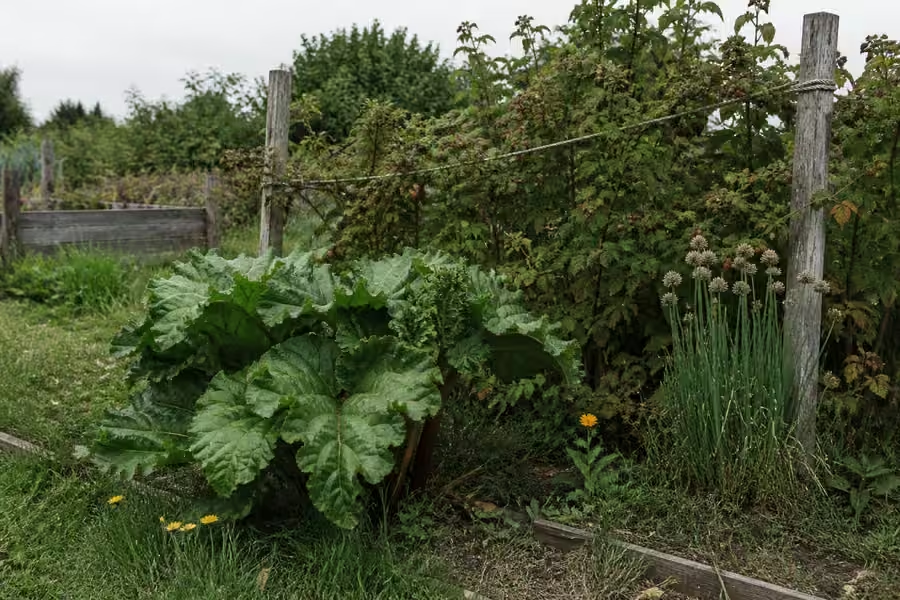
Perennials worth the ground
Rhubarb is the best value on any allotment. One crown, planted once, gives five or six weeks of pulling from April and will still be cropping in fifteen years. A barrowload of compost over it each autumn is the whole job. Globe artichokes earn a corner if you actually like them. Jerusalem artichokes crop enormously for no work whatsoever, but leave one tuber behind and you have them forever, so put them somewhere you do not mind that happening.
The one fruit with no summer job
Autumn fruiting raspberries are cut to the ground in February and that is the entire pruning. No canes to tell apart, no tying in, no summer work at all. They crop from late August into October, which lands neatly in a gap. Summer raspberries taste marginally better and cost you a proper support, an afternoon of tying in and a pruning job you have to get right every year. On a half plot short of time, the autumn ones win comfortably.
Let things seed themselves
Leave one rocket, one land cress and one coriander plant to flower and set seed each year and you will not sow them deliberately again. Chard and parsley do the same. Move the seedlings that come up in the wrong place or hoe them off, but stop buying the packets. Borage and calendula left in the corners bring in hoverflies, whose larvae eat blackfly, which is one fewer job on the broad beans in May.
Five things worth dropping, and what to do with the space
Doing less means genuinely growing less, not growing the same amount more cleverly. These are the usual candidates on a half plot. None of them is a bad crop and none of this is a rule. Each one simply costs more ground and more weeks than it returns once time is the thing you are short of.
| Drop this | Why it does not earn its space | What to do with the bed instead |
|---|---|---|
| Sweetcorn | Needs a block of twelve plants to pollinate, and gives one meal each | A second courgette plant, or another row of beans |
| Maincrop potatoes | Holds a whole bed from March to September, and is cheap to buy | Grow first earlies only, and buy the maincrop |
| Brussels sprouts | Eight months in the ground for one dinner, and every pest wants them | Kale in the same space, picked from November through to May |
| Cauliflower | Unforgiving. Check it once for water and it bolts | Purple sprouting broccoli, which crops for eight weeks rather than one day |
| Bedding annuals | Sowing, pricking out, hardening off and planting, every single year | A permanent row of autumn raspberries, or a rhubarb crown |
Dropping five things is what makes room for doing the rest properly.
Maincrop potatoes
A 4m row returns 10 to 15kg. That is a sack of perfectly good potatoes for about £15 in a supermarket, and it holds a quarter of your growing space from April to September, with a blight watch through August as well. Earlies are a completely different argument: a first early dug in June tastes of something you cannot buy at any price, and the ground is clear by early July for leeks or autumn salad. Keep the earlies, drop the maincrop, buy the sack.
Sweetcorn
It has to go in a block of at least twelve plants to pollinate properly, it holds a big footprint from late May to September, and it returns one or two cobs per plant across roughly a fortnight. On an acre that is a fair trade. On a half plot it is your best bed given over to a summer, for about two meals.
Cauliflower
The fussiest brassica there is. It wants firm ground, steady feeding and no check at all, and one dry fortnight in the wrong week gives you a curd the size of a golf ball after eight months of waiting. Calabrese and purple sprouting broccoli are far more forgiving on exactly the same ground, and they crop over weeks rather than in a single afternoon.
Brussels sprouts
Nine months in the ground, netted the whole time, staked against the autumn wind, for a crop that peaks in the fortnight around Christmas. If sprouts genuinely matter to your Christmas then grow them and count it well spent, and they are one of very few things standing in January. Just be clear that you are paying for them in bed weeks, and that they are the reason that bed is doing nothing else all year.
Anything you did not eat last year
The hardest one to act on. Think back over the last two seasons and count what actually went on the compost heap rather than into the kitchen. Most plots carry one crop grown out of habit, or because it is simply what allotments grow. Every bed week it takes is a bed week not growing something you would have been glad to carry home.
What to put in the space instead
More of the things you cannot buy in a decent state: broad beans, real salad picked an hour before it is eaten, courgettes taken at 12cm rather than 30, purple sprouting broccoli in March, garlic, autumn raspberries, and enough leeks to genuinely see you through February rather than run out in December.
Growing a lot of a few good things is quieter work than growing a little of everything. It is also, unhelpfully, less interesting to plan in January, which is why so few people do it.
Ten minutes with the seed box, every January
Most of the money wasted on an allotment goes on seed that was already dead when it was sown, and most of the gaps in a row are old seed rather than bad luck or bad weather.
Sort the box once a year, in January, before the catalogues arrive and before you order anything at all. Tip it out, bin what is past it, write down what is genuinely missing, and order only that.
Then store the rest in an airtight box with a sachet of silica gel, somewhere cool and dark inside the house. The shed is the worst place on the site: it swings from freezing to warm and damp and back again, and that cycling is what actually kills seed, not age on its own.
One year. Buy fresh, always
Parsnip, and parsnip alone. There are no exceptions and no clever storage that gets round it. Year old parsnip seed germinates so poorly that a full row comes up looking half sown. Buy a new packet every single year, sow it thicker than feels sensible, and thin later.
One to two years
Onion, leek and shallot from seed. Still usable at two years, but sow noticeably thicker than the packet suggests and expect gaps.
Two to three years
Sweetcorn, parsley, spinach, and peas and beans of every kind. Beans keep better than the books allow if they were properly dry when they went into the box.
Four to five years
Carrot, radish, and the whole brassica family: cabbage, kale, calabrese, purple sprouting, swede, turnip, rocket. A four year old cabbage packet is usually still perfectly good.
Five years and often more
Tomato, cucumber, courgette, squash, pumpkin, lettuce, beetroot and chard. Kept genuinely cool and dry, courgette and squash seed is often still going strong at eight or ten years, which is worth remembering before you buy another packet of four seeds.
What two hours actually looks like, in order
The order matters more than the total. Done in this order, two hours a week holds a half plot in reasonable shape from April to September. Done in whatever order the plot suggests when you walk through the gate, the same two hours disappear into the first bed you happened to look at.
| Minutes | The job | Why it sits here in the order |
|---|---|---|
| 0 to 10 | Walk the whole plot with a bucket and pick whatever is ready | Picking is the only genuinely time critical job, and the walk tells you what else needs doing |
| 10 to 25 | Water only what went in less than three weeks ago, plus anything in pots | Everything else has roots deep enough to find its own water |
| 25 to 55 | Hoe the paths and the bed edges, while the soil is dry | Seedling weeds die in minutes when hoed dry. The same weeds take an hour to dig out wet |
| 55 to 85 | The one seasonal bed job: sowing, planting out, netting or earthing up | The only job on the list that cannot be done a fortnight later |
| 85 to 110 | Tie in, pinch out side shoots, top up mulch, empty the barrow | These are the jobs that stop next month having twice as many |
| 110 to 120 | Write down what you sowed and what you picked | Ten minutes here is worth the whole of next January |
Two hours, in this order, beats four hours in a random order. The order is most of the saving.
First 15 minutes. Walk the whole plot and look
No tools in your hands. Look at every bed, lift a leaf or two, check the netting is still tight to the ground, look under the brassicas for caterpillars and at the broad bean tips for blackfly. Nearly everything that ruins a crop is cheap to fix in the week it starts and expensive a fortnight later. This is the highest value quarter of an hour on the plot and it is the one everybody skips, because it does not feel like work.
Next 40 minutes. Harvest, before anything else
Unpicked crops stop producing, so picking is not the reward at the end, it is the job that keeps the plot cropping. Courgettes and beans in particular: leave one runner bean pod to swell and set seed and the plant reads its work as finished and slows right down. Pick first, even when the beds look untidy and the weeds are calling.
Next 25 minutes. Hoe, then cover
One pass with a sharp hoe over whatever is bare and starting to green over, then something laid across any soil that is going to sit empty for more than a fortnight. Compost, cardboard or a quick green manure. The covering matters more than the hoeing.
Next 20 minutes. Sow or plant the next thing
A metre of salad, a short row of beetroot, the leeks that go in where the broad beans came out. Small and constant is what keeps something arriving in the kitchen in every month rather than all of it in August.
Last 20 minutes. Water only the list
Containers, anything planted in the last three weeks, and the courgettes and beans that are in flower. Everything else waits for rain. If you are short of time this is the job to cut, not the first one.
When you have missed three weeks in July
It happens, and it is usually a holiday. Do not try to catch it all up in one visit, and do not start at the gate and work inwards, because you will spend the entire afternoon on the first bed and go home having achieved one bed.
In order: pick everything ready or nearly ready, even if half of it goes straight on the compost heap, because that is what restarts the plants. Then cut down anything that has flowered and is about to set seed, weed or crop, no matter how far gone. Then water the containers. Then go home.
Weeding waits for the following week. A plot that has been picked and stopped from seeding recovers inside a fortnight. A plot that has been allowed to seed costs you the next three years, and that is the only part of this that is genuinely urgent.
The job that only matters in one particular week.
Sharpening the hoe in May, ordering parsnip seed in January, getting the phacelia sown before the second week of September. One email at the start of each month with the handful of small jobs that decide how much work the rest of the month turns into.
One email a month. Unsubscribe any time.
The three systems, in full
Each of these has its own page with the real numbers: what it costs, what it saves, and when it is the wrong answer.
No dig
What it actually costs in compost on four beds, and the four times a fork is still the better tool.
Two hours a week
Where the hours go month by month, the jobs to drop, and what buys back the most time.
Saving your own seed
The five crops worth saving from, the ones that will waste a bed, and how to store it so it germinates.
Where to go next
Three ways on, depending on whether you are tightening the year, the month or a particular crop.
Still building the year
Rotation, succession intervals and a plan for eating from the plot in every month.
What matters this month
The jobs that are worth doing now, and the ones that can safely wait until next month.
The crops in detail
Spacings, sowing dates and an honest verdict on whether each one earns its bed.