Plan a half plot allotment in an afternoon
Six steps, about three hours, one sheet of paper. At the end of it you will have a plan you can put in your pocket, take to the plot in the rain, and actually sow from.
This is the planning method the rest of the site is built on. It is deliberately low tech, because a plan that lives on a phone is a plan you will not look at with muddy hands in March.
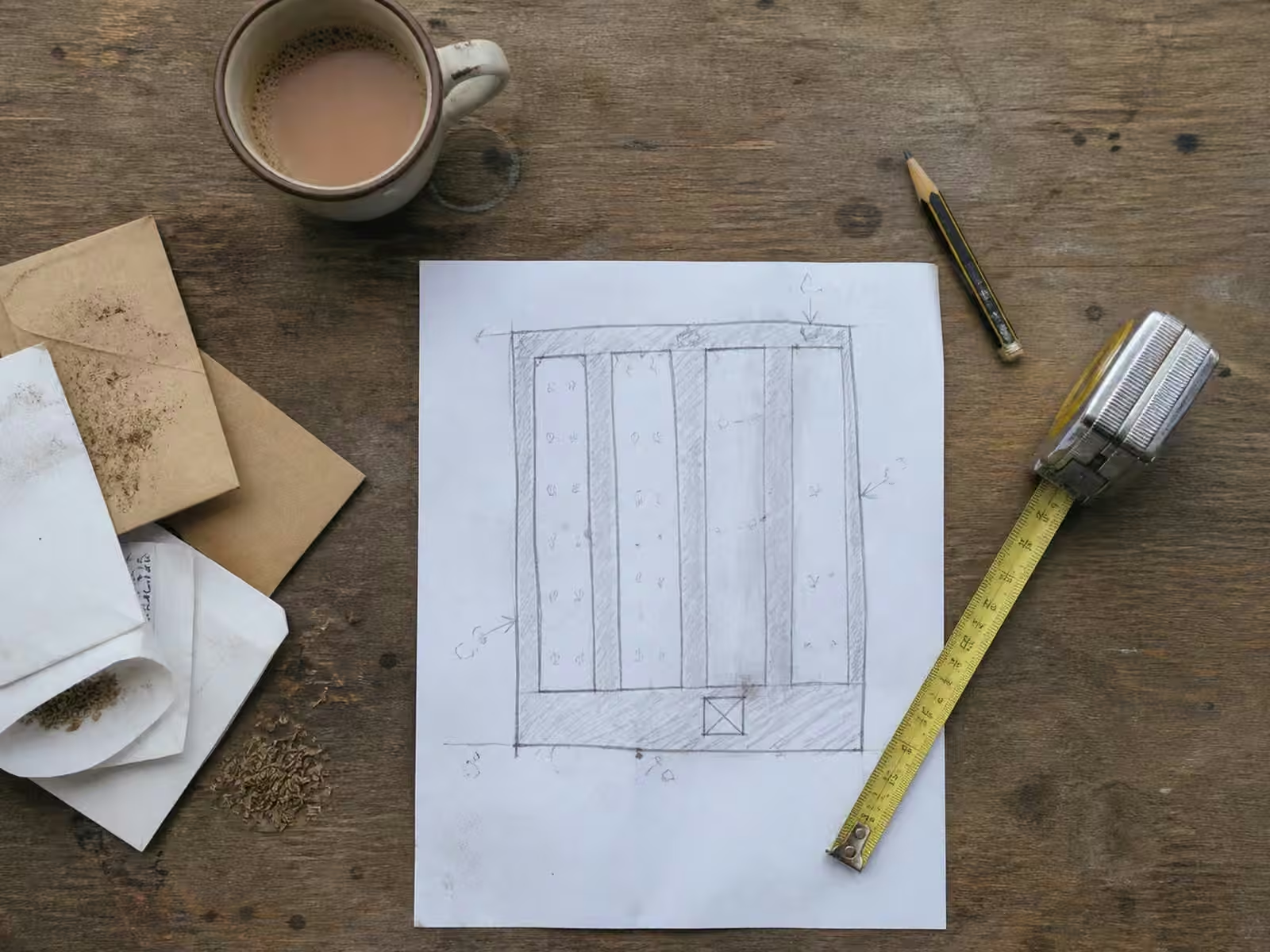
In one afternoon, with a pencil. Draw the plot as it actually is, take out the paths and the shed, then split what is left into four beds you can reach across. Give every crop a bed, a rotation group and a quantity, then put a sowing date and a planting date against every line.
What you need
One sheet of plain A4. A pencil with a rubber on the end, because you will change your mind four times. A tape measure, or your own pace length if you have not got one. Last year’s seed box if you have one. About three hours, split between the plot and the kitchen table.
No apps, no spreadsheets and no planning software. Every one of them is better than paper at drawing a neat plot and worse at being read in the rain with cold hands, which is the only moment the plan has to work.
What you will have
One sheet with the plot drawn to scale, paths and compost bays marked, four beds numbered, a rotation group written in each one, roughly eight to ten crops assigned with quantities, a sowing month and a picking month against each crop, and four jobs to do first.
That sheet then gets pinned inside the shed door and annotated in a different colour all season. In January it becomes next year’s plan in about twenty minutes, because the hard thinking is already on it.
Draw the plot as it actually is
Measure it properly rather than guessing. If you have no tape, walk 10m alongside one with a neighbour once and count your paces, then use that. Most adults pace somewhere around 75 to 80cm, and knowing your own number turns every future measurement into a walk.
Draw it on plain paper at one centimetre to one metre. A plot of 10m by 12.5m becomes a rectangle of 10cm by 12.5cm, which sits in the middle of an A4 sheet and leaves you room to write around the edges. Half plots vary far more than people expect, from about 100 to 150 square metres and in every shape from a neat rectangle to a long thin strip, so draw yours rather than a diagram from a book.
Then mark six things on it, and resist marking anything else until they are all down.
The six things to mark
1. North. Use the compass on your phone. Tall crops go along the northern edge so they are not shading everything else by July.
2. The gate and the tap, with the distance to the tap written on. If it is 40m away, that single number will decide what you grow and how you water for the next five years.
3. Where the shade falls at midday. Stand there at lunchtime, or read it off the ground: thin, mossy or bare grass is telling you where the sun does not reach.
4. Where water sits after rain. If you took the plot on in summer, ask whoever has the plot next door. Every site has one corner that is under water in February.
5. Anything permanent you are keeping. Shed, rhubarb, fruit bushes, an established asparagus bed. These are fixed points, so the plan goes around them.
6. What arrives over the boundary. Couch grass from the uncultivated plot next door, bramble from a hedge, shade from somebody’s runner beans. Mark the direction it comes from, because that edge will need a permanent answer.
A bed wider than 1.2m means standing on the soil to reach the middle. Once you stand on it, you are digging it again every spring.
Take out everything that is not growing space
This is the step almost everybody skips, and skipping it is why most first plans do not survive contact with the plot. Paths, compost bays, the shed and somewhere to stand are not the leftovers around your growing space. They come out first, and what remains is the plot.
Draw them on in pencil now, to scale, before a single vegetable goes on the sheet.
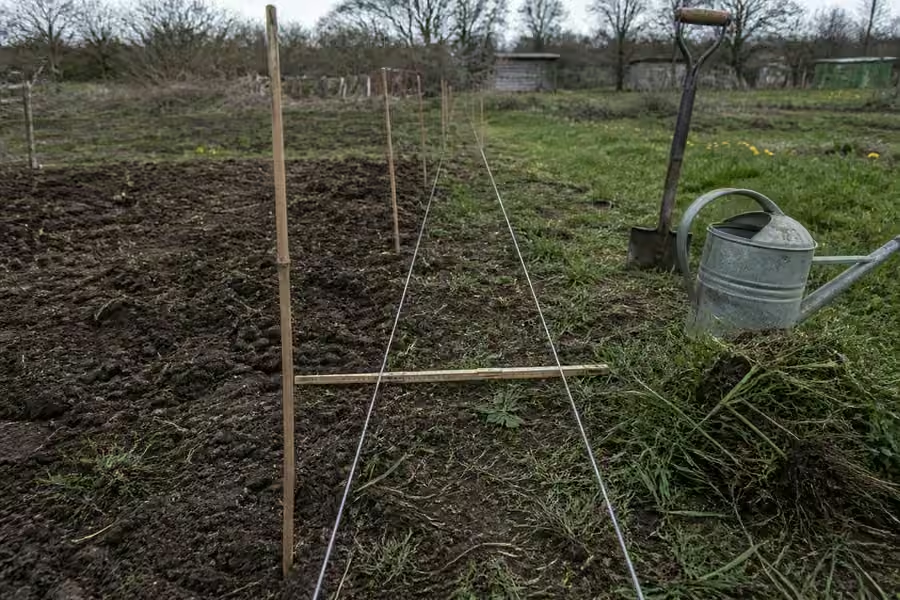
Beds 1.2m wide, never wider
That is the widest bed an average adult can reach the middle of from both sides. The entire purpose of a bed is that you never put a foot on it, and a bed you have to step into to weed is not a bed. Length is up to the plot: 8m suits a typical half plot, but 4m or 6m works just as well. Only the width is fixed.
Paths at 60cm and 40cm
One main path at 60cm, because that is what a loaded wheelbarrow needs with your feet either side of it. Side paths at 40cm, enough to kneel in. Go narrower than 40cm and you will end up standing on the beds by June, which quietly undoes everything the beds were for.
Compost takes real space
Two bays of about 1m by 1m side by side, one filling while the other rots down, plus a metre in front to stand and turn into. Put them at the far end, where a barrow can reach them and where you do not mind looking at them. One bay is not enough and three is a half plot pretending to be a farm.
Now do the subtraction
On a 125 square metre plot: four beds and one perennial strip at 1.2m by 8m is 48 square metres of growing ground. Paths take around 25. Shed, butts, compost and standing room take around 15. That leaves about 37 square metres over.
So you are planning 48 square metres, not 125
That is the number the rest of this plan uses, and it is worth sitting with for a minute because it looks wrong. Less than half the plot is under crops. The 37 square metres left over goes under cardboard in year one, and later becomes a fifth bed, a fruit patch, or simply stays as mown grass with the barrow parked on it.
This is not a failure of ambition. Forty eight square metres, properly worked, is roughly what two to four hours a week actually covers, and it will produce more food than most households can eat fresh. A plan showing 125 square metres of vegetables is a plan drawn by somebody who has not yet drawn the paths.
Write down what your household actually ate last week
Leave the plot for this one and go and sit down properly. Fifteen minutes here decides more about whether you enjoy the next five years than anything else on the sheet.
Write out the vegetables your household genuinely ate in the last seven days. Not the ones you mean to eat more of, not the ones in the catalogue photograph, not the ones that would make the plot look serious. The ones that went on plates.
Then go through that list twice, in this order.
Cap the result at eight to ten crops for a first year, and twelve to fifteen once you know the plot. Everybody plans more than they sow, and everybody sows more than they pick, so build the shrinkage in at the start rather than discovering it in July.
The two passes
First pass, cross off anything you can buy in good condition, cheaply, all year, that also stores perfectly well. Maincrop potatoes, onions in an ordinary year, winter carrots, swede. None of them is a bad crop. They are simply the ones where the shop version is nearly as good, and where the bed could be doing something you cannot buy.
Second pass, circle anything expensive, poor quality or simply unavailable in a shop. That circle is your priority list, and it is usually shorter and more obvious than people expect. Salad leaves that were not picked four days ago. Broad beans. Purple sprouting broccoli. Courgettes taken at 12cm rather than 30. New potatoes dug the same afternoon. Garlic. French beans. Chard. Fresh herbs.
For anything you are still unsure about, one question settles it: would I be genuinely pleased to carry this home? If the honest answer is no, it does not go on the plan, however easy it is to grow and however good the picture on the packet.
Writing down what you actually ate last week is the most useful hour in the whole plan, and the one everybody skips.
Give every crop a bed, a group and a quantity
Number your four beds one to four. Each bed gets a rotation group, and every year the groups move one bed along, so the crops travel and the beds stay put. Four groups over four beds means each family of crops returns to the same ground once every four years, which is enough to keep most soil borne trouble at bay.
| Bed | Rotation group | What goes in it | Why it sits here |
|---|---|---|---|
| Bed 1 | Potatoes | First and second early potatoes | The foliage smothers weeds and the digging breaks up new ground |
| Bed 2 | Legumes | Broad beans, runner beans, peas | They leave nitrogen behind for whatever follows |
| Bed 3 | Brassicas | Purple sprouting, kale, spring cabbage | Follows the legumes and takes the nitrogen. Needs firm soil and netting |
| Bed 4 | Roots and onions | Onions, carrots, beetroot, leeks | Wants the least rich soil, so it comes last in the cycle |
Move each group one bed along every year and the whole rotation looks after itself.
Potatoes
This is the bed that gets the compost. Potatoes are hungry, they tolerate rough ground, and the earthing up and lifting breaks up soil better than anything else you can plant on a neglected plot.
Beans and peas
Follows the potatoes into loose worked soil, which suits them. Cut the plants off at ground level when they finish and leave the roots in, because the nitrogen they fixed is in the roots and the next crop wants it.
Brassicas
Cabbage, kale, calabrese, purple sprouting, swede and turnip, following the beans and using the nitrogen they left. Wants firm ground, so do not dig it first, and netted from the day it goes in.
Roots and onions
Carrots, beetroot, parsnips, onions and garlic go last, into ground that has had no fresh compost for three years. That is deliberate: fresh compost is exactly what makes carrots and parsnips fork.
How much of each, for a household of four
Quantities are where plans go wrong far more often than spacings do. These are the numbers for feeding four people well rather than for filling a bed, and most of them are smaller than instinct suggests. Pick eight to ten of these for a first year, not all eleven.
First early potatoes
20 to 25 seed tubers. Chit them in an egg box on a cool light windowsill in February, plant mid March to early April, 12cm deep and 30cm apart with 60cm between rows. Takes about 4.5 square metres, so half a bed. Expect 15 to 25kg from late June, and the ground is clear by mid July for leeks or autumn salad, which is half the reason to grow earlies rather than maincrop.
Broad beans
A double row 4m long: seeds 20cm apart along the row, the two rows 45cm apart, about 40 plants. Sow in the first half of November for a May crop, or February to March for June. Takes around 2 square metres and gives 8 to 10kg of pods, which is less food than it sounds because a broad bean pod is mostly pod.
Runner or French beans
Eight to ten canes in a double row, two seeds at each cane and pull the weaker seedling. Sow indoors in late April or direct in late May once the soil has warmed. About 2.5 square metres, and it will out-produce a household of four from late July until the first frost. Ten canes is plenty. Twenty canes is how people end up leaving carrier bags at the gate in August.
Courgettes
One plant. If you genuinely love them, two. Sow indoors late April, plant out in early June, allow a square metre each. One plant gives 20 to 30 courgettes through August and September if you pick them at 12cm rather than letting them run to marrows. This is the crop people get most wrong and the error is always in the same direction.
Onion sets
About 100 sets pushed in 10cm apart, rows 25cm apart, in March. Roughly 2.5 square metres, and 100 onions is most of a year for most households. Stop watering at midsummer and let the tops bend and dry, or they will go soft in store before November.
Garlic
30 to 40 cloves planted in October or November, 15cm apart in rows 25cm apart, about 1.5 square metres. It needs a genuine cold spell to split into a proper head of cloves, which is why autumn planting beats spring by a long way. Plant the cloves from a seed garlic bulb, not a supermarket one.
Leeks
40 plants at 15cm apart, rows 30cm apart, about 1.8 square metres. Sow in March, plant out in June by dropping each seedling into a 15cm dibbed hole and filling the hole with water rather than soil. Stands in the ground from December through March and is the most useful single crop on a winter half plot.
Purple sprouting broccoli
Four plants at 60cm each way, about 1.5 square metres. Sown in May, planted out in June, netted the whole time against pigeons and cabbage white, and it gives you absolutely nothing until March. Then it crops for six weeks in the emptiest stretch of the year, which is the only reason it earns nine months of a bed.
Salad leaves
One metre of row, sown every fortnight from March to September. Never more than a metre. A metre of cut and come again lettuce, rocket and land cress keeps two people going for a fortnight and then bolts, which is exactly what you want it to do rather than something to be avoided.
Beetroot
A 2m row every three weeks from April to July. Sow the clusters 10cm apart and thin each one to a single seedling. Golf ball size is the point they are worth eating, and the reason to sow in short runs is that a whole row reaches that size in the same week.
Carrots
A 3m row sown thinly in May and thinned to 5cm apart. Cover with fine mesh from the day you sow, not from the day you see damage, because carrot fly finds them by smell and thinning is what releases it. Never sow into freshly composted ground or the roots fork.
Put two dates against every line
A plan without dates is a list of good intentions. Against each crop write two things and nothing more: the month it gets sown or planted, and the month you expect to pick it.
Then read straight down the picking column and count the months that appear. Almost every first plan comes out with the same shape. Nothing at all against March, April and May, and four or five crops piled into August.
That is not bad luck and it is not a beginner’s mistake. It is a hungry gap and a glut, and you have just designed both of them into your own plot on paper in January, where they cost nothing to fix. Fixing them in April, with an empty bed and nothing sown, is not possible at all.
| Crop | Sow | Plant out or thin |
|---|---|---|
| Broad beans | Early November, or late February | Thin to 20cm apart |
| First early potatoes | Chit from February | Plant mid March to early April |
| Onion sets | No sowing | Plant mid March to mid April |
| Courgettes | Indoors, late April | Plant out at the end of May |
| Purple sprouting broccoli | Early May | Plant out mid June at 60cm |
| Spring cabbage | Mid August | Plant out mid September |
| Salad leaves | Every three weeks, March to September | Thin to 10cm |
| Garlic | No sowing | Plant cloves in October |
Two dates per line is the whole trick. A plan without dates is a wish list.
To fill March and April
Purple sprouting broccoli, sown the previous May and planted out in June. Spring cabbage, sown in mid August and planted out in September. Both spend the best part of a year doing nothing visible, which is exactly why they get left off plans, and exactly why the plots that have them are the ones with something worth picking in April.
To fill May and June
Broad beans sown in the first half of November crop three to four weeks ahead of a spring sowing, and largely dodge blackfly by being past the vulnerable stage before it arrives. Garlic planted in October. Hardy salad sown in September under a cloche. All three are autumn jobs for a spring problem.
To fill December to February
Leeks sown in March and planted in June. Kale sown in May. Parsnips sown in April from a fresh packet. All of them stand out in the ground through hard frost and get pulled as you want them, which means the plot itself is the store and you do not need a shelf, a clamp or a freezer.
To stop August arriving at once
Sow in short runs rather than full rows. A metre of salad every fortnight. A 2m row of beetroot every three weeks. Two sowings of French beans three weeks apart instead of one long row. The interval between sowings matters far more than the total quantity, and it is the single change that turns a glut into a supply.
Write the four things you will do first
A plan becomes useful at the exact moment it turns into this week’s jobs. Four lines at the bottom of the sheet, in order, each one small enough to finish in a single visit.
1. Order seed potatoes and garlic this week, because both sell out by the end of January.
2. Mark out bed one with string and canes on the next dry visit.
3. Get cardboard down over the 37 square metres I am not using this year.
4. Sow nothing at all until March.
The fourth line does more work than the other three put together. Most first plans come apart not because too little was planned, but because sowing began in a warm week in February and everything that came up was checked by frost in April.
Then pin the sheet inside the shed door and annotate it in a different colour all season: what actually got sown and when, what failed, what you ran out of in February, what you gave away in August. In January that annotated sheet turns into next year’s plan in about twenty minutes, because all the hard thinking is already on it.
When the plan goes wrong
It will, and usually by the end of June. Something does not get sown, a bed is not clear when the next thing needs to go into it, or a fortnight of rain takes out three visits in a row.
The plan is not there to be followed exactly. It is there so that you are not making the decision in a hurry, in the rain, holding a tray of leeks with nowhere to put them.
If a sowing is more than three weeks late, skip it and move to the next thing in the sequence rather than sowing it anyway. A late sowing usually ends up occupying the bed that the following crop needed, so one slipped date quietly becomes two.
If a bed is not ready and the plants are, put them in anywhere you can find 15cm of space rather than holding them in modules for another fortnight. A seedling that has been checked in a small pot rarely catches up, and a leek in the wrong bed still makes a leek.
Questions that come up
The six that get asked most often about this method, answered plainly.
How big is a half plot, exactly?
Around 125 square metres is the usual figure, about five parking spaces, but it varies a great deal between sites. Some are 100, some are 150, and a few sites hand out what they call a half that is really a quarter of a full plot. Measure yours rather than trusting the number on the tenancy agreement, because every quantity in this method comes off that measurement.
Do I need raised beds?
No, and on a half plot they are usually not worth the money. A bed needs to be marked, not raised. String and four canes will do it, and the only thing that genuinely matters is that you stop walking on the growing ground. If you do want edges, scaffold boards are cheap or free from building sites and last about eight years. Worth knowing before you commit: timber edges harbour slugs, and a deep raised bed dries out considerably faster in July, which on a plot with a distant tap is a real and recurring cost.
Which way should the beds run?
North to south if the shape of the plot gives you a genuine choice, so both sides of a bed get sun across the day. In practice the shape of the plot, the position of the gate and wherever the shed already stands will decide it for you, and it matters a great deal less than it is usually made to sound. Getting the bed width right matters far more than getting the direction right.
I took the plot on in July. Should I wait until January to plan it?
No. Plan it the week you get it and plan for autumn rather than spring. A July or August start is genuinely good timing rather than a false one: you can clear ground while it is dry and the weeds are visible, get garlic and overwintering onion sets in during October, sow broad beans in November, and then arrive at your first spring with cleared ground and three crops already in it, which is well ahead of somebody who started in March.
How many years before the plan is right?
Three, roughly. The first plan is an educated guess, the second is a correction, and the third is usually close to right for your plot and your household. The annotated sheet is what carries the learning between them, which is why the scribbling on it through the season matters rather more than the drawing did.
Should I use a planning app instead?
Use one as well if you like them. Draw the paper version first though, because the apps are better at neat layouts and reminders and worse at the two things this method actually depends on: making you draw the paths before you draw a single crop, and being readable with wet hands in a wind.
Where this comes from
The bed sizes, the path widths and the four bed plan are a working setup rather than a rule. The rotation the plan is built around is a real principle with real reasons behind it.
- RHS, Crop rotation, on the groupings and why the gap between the same crop returning matters
- RHS, Couch grass, on the running roots that decide how you clear ground before you build beds on it
Last reviewed 17 August 2026.
Written by Sam
Eight years on a half plot in Nottinghamshire. Four beds, two water butts, about two hours a week, and most of what is on this site tried twice before it worked. Dates here suit most of England and Wales, because that is where the plot is. Where a page makes a claim you could check for yourself, it links to the source.
The sowing you need to make now, for a crop in March.
Half of this plan depends on jobs done six months before you eat anything, and those are exactly the ones a plan on a shed door does not shout about. One email at the start of each month with what to sow now for later.
One email a month. Unsubscribe any time.
Where to go next
The plan is drawn. These are the three things people read straight after it.
Decide what goes in it
Five crops that are reliable, forgiving and genuinely worth the space in a first year.
Clear the ground first
If the plot is waist high, the plan waits. A staged method that clears a quarter at a time.
Fix the two gaps you just found
The empty spring and the crowded August, dealt with properly rather than survived.