Your rights as an allotment tenant
What the law actually says about your plot: how much notice you must be given, what you are owed if the site closes, and the one clause that takes twelve months down to three. Written from the Acts themselves, with every section linked.
In short
In England and Wales your plot sits under four Acts of Parliament, and where your tenancy agreement contradicts them the Acts win. On a statutory allotment garden you are owed twelve months notice to quit, compensation of one year rent if the council ends the tenancy, and the right to keep hens and rabbits. Scotland has its own rules, and they are stronger.
On this page
- Which laws apply to your plot?
- Is your site statutory or temporary?
- How much notice must you be given?
- When does twelve months become three?
- What are you owed if you lose the plot?
- Can you be evicted for letting it go weedy?
- Can you keep hens or rabbits?
- What if your council has no allotments at all?
- The rules are different in Scotland
- Where the half plot odd size comes from
- Sources
Which laws apply to your plot?
Your tenancy agreement is the document you signed. Underneath it sit four Acts of Parliament that are still in force, and where the agreement contradicts them, the Acts win. Most of the arguments lost on a site are lost by someone who has only ever read the agreement.
| Act | What it does for you | Section |
|---|---|---|
| Small Holdings and Allotments Act 1908 | Puts a duty on the council to provide plots where there is demand, and gives six electors the power to make them consider it | s.23 |
| Allotments Act 1922 | Defines an allotment garden in law, sets the notice rules and their exceptions, and gives you compensation for crops and manure | ss.1, 22 |
| Allotments Act 1925 | Stops a council selling or building on a statutory site without the minister consenting | s.8 |
| Allotments Act 1950 | Raises the notice to quit from six months to twelve, adds compensation for disturbance, and allows hens and rabbits | ss.1, 3, 4, 12 |
This is England and Wales. Scotland is covered further down, and in several respects it is better. Northern Ireland is different again and is not covered here.
This week: find your tenancy agreement, and ask your site secretary whether the site is statutory or temporary. Those two answers decide everything below, and most plotholders have never been told the second one.
Is your site statutory or temporary?
This is the most important thing to know about your site, and most plotholders have never been told which they are on. It makes no difference to your notice period. It makes all the difference to whether the site still exists in twenty years.
A statutory allotment is land the council bought or formally appropriated for use as allotments. Section 8 of the Allotments Act 1925 says the council shall not sell, appropriate, use or dispose of that land for any purpose other than allotments without the consent of the minister. Consent can only be given where the minister is satisfied that adequate provision will be made for the allotment holders who are displaced, or that such provision is unnecessary or not reasonably practicable.
A temporary allotment is land the council leases from someone else, or holds for another purpose and is letting out as allotments in the meantime. It carries none of that protection. When the lease ends or the other purpose arrives, the site goes, and nobody has to ask a minister anything.
The question to ask, and how to ask it
Ask your council allotment officer, in writing: is this site held as statutory allotment land under the Allotments Acts, or is it temporary? Ask for the answer in writing too. It is a matter of public record, it takes them a minute to look up, and it is the first thing any campaign to save a site has to establish. Keep the reply.
How much notice must you be given?
Twelve months, and it has to land in the right part of the year.
Section 1 of the Allotments Act 1922 says a tenancy of an allotment garden cannot be ended by notice to quit except by a notice expiring on or before the sixth day of April or on or after the twenty-ninth day of September in any year. Section 1 of the Allotments Act 1950 then raised the length of that notice from six months to twelve.
Read together: you must be given twelve months notice, and it must expire either on or before 6 April or on or after 29 September.
Those two dates are not bureaucratic. They are the ends of the growing season. The Act is making sure nobody is turned off the ground in July with a bed of half grown onions in it, and it has been doing that job since 1922.
When does twelve months become three?
This is the part most explanations leave out, and it is the part that actually costs people their sites.
The twelve months applies to an ordinary notice to quit. Section 1 of the 1922 Act sets out separate grounds on which a landlord may re-enter with far less warning.
| Ground | Notice | Where |
|---|---|---|
| The land is needed for building, mining or any other industrial purpose, or for roads or sewers required for those | 3 months in writing | s.1(b) |
| A railway, dock, canal or utility company needs land for the purpose it was acquired for | 3 months, except in an emergency | s.1(c) |
| A local authority needs land it acquired before 1922 under the Housing Acts | 3 months in writing | s.1(d) |
| Non payment of rent, breach of a term of the tenancy, or the tenant becoming bankrupt | re-entry under the agreement | s.1(e) |
Paragraph (b) is the one to understand. If the ground is wanted for building, twelve months is not what you get. Three is.
This is exactly why the statutory question matters so much. On statutory land the council still has to get the minister to consent under section 8 of the 1925 Act before the site can go, and that is a real hurdle with a real test attached to it. On temporary land there is nothing in the way at all.
What are you owed if you lose the plot?
Two separate payments, and you can claim both.
Compensation for disturbance
Section 3 of the Allotments Act 1950. Where the landlord ends the tenancy, you are entitled to one year rent of the land at the rate at which rent was payable immediately before the tenancy ended, or a proportion of it if only part of the plot goes. The Act says this is in addition to any other remedy you have, not instead of it.
Compensation for crops and manure
Section 2 of the 1950 Act, amending the 1922 Act, gives you the value of the crops standing on the plot and of the manure you have put into it. The 1950 Act also removed the old restriction that confined those claims to the window between 6 April and 29 September, so the month you happen to be in no longer decides whether you can claim at all.
Be honest about the amounts
Nobody gets rich on this. A year rent on a half plot is somewhere around thirty to sixty pounds, which is a bag of compost and a coffee. The reason to know the figures is not the money. It is that being owed something, and saying so in writing and citing the section, changes the tone of a conversation with a council that would rather you simply went quietly.
Can you be evicted for letting it go weedy?
Yes, and this is the ground people actually lose plots on. Site closures are rare. Cultivation notices are not.
Section 1(e) of the 1922 Act preserves the landlord right to re-enter for breach of any term or condition of the tenancy. Almost every tenancy agreement in the country carries a term requiring the plot to be kept clean and in a good state of cultivation, and most put a figure on it, commonly 75 per cent under cultivation. Breach that and the twelve months does not help you, because this is re-entry under the agreement rather than a notice to quit.
It runs in the other direction too. Section 4 of the Allotments Act 1950 lets the landlord recover compensation from you for any deterioration of the land caused by your failure to maintain it clean and in a good state of cultivation and fertility, measured as the cost of making that deterioration good at the date you leave.
In practice councils send a cultivation warning first, usually with 28 days to reply, and almost every site will work with anyone who answers the letter. Illness, a new baby, a bad year: these are normal and sites know it. The plots that get taken back are overwhelmingly the ones whose holder went quiet.
This week
Find the cultivation clause in your own agreement and read the percentage. If you are behind, write to the site secretary before they write to you, with a plan and a date on it. A stated plan is almost always accepted. Silence is not.
Can you keep hens or rabbits?
Yes, and it is a statutory right rather than a favour from the site.
Section 12 of the Allotments Act 1950 says that, notwithstanding any provision to the contrary in any lease or tenancy, the occupier of land may keep hens or rabbits in any place on the land otherwise than by way of trade or business. A clause in your agreement that simply bans them is running against the Act.
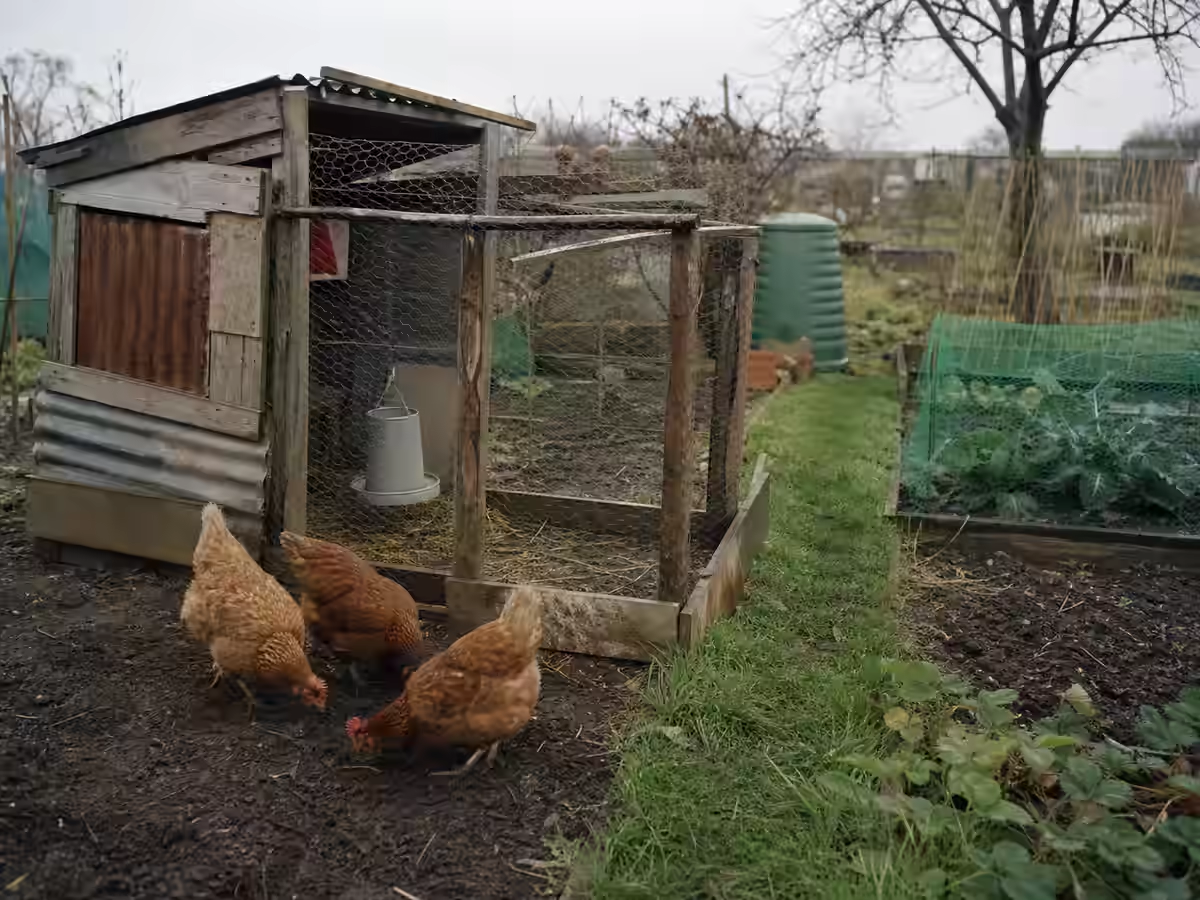
It is not unlimited. The section is subject to any other legislation, and it does not protect you where the birds or animals create a nuisance or a health hazard.
| What the section covers | What it does not |
|---|---|
| Hens and rabbits | Ducks, geese, goats, pigs or bees, which are governed by your site rules alone |
| Keeping them for yourself and your household | Keeping them by way of trade or business, which falls outside section 12 entirely |
| Whether you may keep them at all | Nuisance, noise, vermin and public health law, which still apply in full |
Cockerels are the usual flashpoint. They are hens in the ordinary sense, but a cockerel at five in the morning is a textbook nuisance, and that is the ground most sites ban them on rather than section 12.
In practice most councils accept that a site rule can govern how and where you keep hens, but not whether. If you want hens, raise it with the committee citing section 12 rather than asking permission, and expect a conversation about siting, foxes and who feeds them when you are away.
What if your council has no allotments at all?
There is a mechanism for this and it is well over a century old.
Section 23 of the Small Holdings and Allotments Act 1908 says that where a council are of opinion that there is a demand for allotments, they shall provide a sufficient number of allotments and let them to residents who want them.
The lever sits in the same section. On a representation in writing by any six registered parliamentary electors or council tax payers resident in the area, saying that the circumstances are such that it is the council duty to act, the council shall take that representation into consideration.
Six signatures, and that is the whole threshold
Be clear about what it does and does not do. It compels the council to consider, not to build, and it comes with no deadline attached. But it is a formal statutory representation rather than a complaint or a petition, it goes on the record, and a council that brushes one aside is in a poor position later. If there is no site near you, this is a letter with six names on it, addressed to the council monitoring officer, citing section 23 of the Small Holdings and Allotments Act 1908.
The rules are different in Scotland
Scotland replaced the old Acts for allotments with Part 9 of the Community Empowerment (Scotland) Act 2015, and it asks considerably more of councils than anything in English or Welsh law.
| Duty | What the Act requires | Section |
|---|---|---|
| A waiting list | Every local authority must keep a list of residents who have requested an allotment | s.111 |
| Size of plot | An entitlement to a plot of around 250 square metres, or smaller if you ask for smaller | s.110 |
| A cap on the list | Reasonable steps so the waiting list does not exceed half the number of allotments the authority owns or leases | s.112 |
| A cap on the wait | Reasonable steps so that nobody remains on the list for a continuous period of more than five years | s.112 |
The two duties in section 112 are the ones with teeth, and there is no equivalent anywhere in the law of England and Wales.
The practical difference is worth stating plainly. A Scottish council with 200 plots and 400 people waiting is failing a statutory duty and can be told so. An English council in the same position is simply oversubscribed, and there is nothing in the 1908 Act that puts a number or a clock on it.
Where the half plot odd size comes from
A standard plot is ten poles. Everyone on a site uses the number and almost nobody is ever told what a pole is.
A pole, also called a rod or a perch, is an old land measure of five and a half yards. A square pole is 30.25 square yards, or 25.29 square metres. Which gives you this.
| Plot | Poles | Square metres | Square yards |
|---|---|---|---|
| Full plot | 10 | 253 | 302 |
| Half plot | 5 | 126 | 151 |
| Quarter plot | 2.5 | 63 | 76 |
| The legal maximum for an allotment garden | 40 | 1,012 | 1,210 |
That last row is the statutory ceiling, not a normal plot. Nobody is being handed forty poles.
The last row comes from section 22 of the Allotments Act 1922, which defines an allotment garden as an allotment not exceeding forty poles in extent which is wholly or mainly cultivated by the occupier for the production of vegetable or fruit crops for consumption by himself or his family.
Two things fall out of that definition that matter more than they look.
Forty poles is the ceiling for legal protection, not the usual size. Above forty poles the land is not an allotment garden, and none of the notice periods or compensation above attaches to it.
The phrase about consumption by himself or his family is doing real work. The protection attaches to growing food to eat. A plot that is mainly lawn, mainly flowers or mainly shed is, on the wording of the Act, not an allotment garden at all. That single clause from 1922 is the legal root of every cultivation rule on every site in the country, and it is why the percentage in your agreement exists.
The five and a half yard pole is also why a cricket pitch is 22 yards, which is four poles, or one chain. The measure is medieval, it survived into the 1908 and 1922 Acts unchanged, and it is the reason your plot is an awkward 126 square metres rather than a round 100.
Sources
Every statement on this page is taken from the legislation itself rather than from secondary summaries. The Acts are all in force and all free to read.
- Small Holdings and Allotments Act 1908, section 23, the duty to provide and the six elector representation
- Allotments Act 1922, section 1, notice to quit and the grounds for re-entry at three months
- Allotments Act 1922, section 22, the definition of an allotment garden and the forty pole limit
- Allotments Act 1925, section 8, ministerial consent before statutory allotment land is disposed of
- Allotments Act 1950, sections 1, 2, 3, 4 and 12: twelve months notice, compensation for crops and manure, compensation for disturbance, the landlord claim for deterioration, and hens and rabbits
- Community Empowerment (Scotland) Act 2015, Part 9, sections 110 to 112
- Scottish Government guidance to local authorities on Part 9
One caveat, and it is a real one
This is a plain English reading of the Acts, not legal advice, and it is written from the England and Wales position unless the Scottish section says otherwise. The Acts have been amended over a century and your tenancy agreement, your council standing orders and your site rules all sit on top of them. If you are facing losing a plot or a site, take the sections above to your site association, to the National Allotment Society, or to a solicitor. Do not rely on a gardening blog for that.
Written 17 August 2026 from the current text of each Act on legislation.gov.uk. If you find something out of date here, tell us and it will be corrected.
Written by Sam
Eight years on a half plot in Nottinghamshire. Four beds, two water butts, about two hours a week, and most of what is on this site tried twice before it worked. Dates here suit most of England and Wales, because that is where the plot is. Where a page makes a claim you could check for yourself, it links to the source.
The month the notice dates actually matter
Nothing here needs reading twice a year. One email a month with what the plot needs now, and a note when something on the site changes.
One email a month. Unsubscribe any time.
Where to go next
The law is the floor. These are the pages about actually running the plot.